Search This Blog

Followers

Monday, 5 April 2021

A Week in the Life of a Full Time Unpaid Carer.


Village Magazine article, April 2021.

As the Village Magazine came this morning, I set myself the task of writing A Week in My Life, anonymously for privacy. I have cared for my wife during the last 5 years of serious disability (brain damage and paralysis), mostly housebound. The Census set a top figure of 50+ hours for unpaid caring of a dependant at home. 24/7 for 52 weeks comes to 168 hours a week, less sleep time when we get it – 5 hours is typical, possibly broken, so I deduct 35 hours to 133 working hours per week. Across the year that is 6916 hours, unpaid. As a paid employee on a 40 hour week the total over a 52 week year is 2080 hours. The unpaid carer total is thus equivalent to 3.3 years paid work crammed into one. And for no pay. This is for context.

Monday. Up at 7, shower, shave etc. Black tea. General tidying and washing up. Fed and medicated the cats. 15 minutes for twitter, 15 more for emails. My band of online carers have survived the night and tell me how horrible the world has become. I will chat with them across the day. 9.15 carer arrives to help me wash, dress and get my wife up. That takes 30-45 minutes. My wife has little language and no memory so chatting not possible. Her breakfast is banana, bun and then various healthy options. Urgent for the day is fluids as she is dehydrated. Friend from Belgium rang (work) and we sorted our lives out. Urgent shopping so a sitter came in. 2 hours work (I am a writer). 4-6pm her teatime and bedtime. Drinks by syringe throughout the day to rehydrate her. 7.15pm, pour drink, friend is on Radio4, relax. 8-10pm, writing with my supper. At 11pm, she is quiet now. In bed by midnight with voice monitor on.

Tuesday. Couldn’t sleep last night, that will have complications later. Same routine as Monday up to breakfast but managed an hour sleep on the sofa afterwards.. Today’s task is getting to hospital for an MRI scan. I went deaf in the left ear 3 weeks ago, with tinnitus. 10 days on 13 pills a day have wrecked my tastebuds (reflux) and my dry mouth has murdered sleep. Again, a sitter needed. MRI scan done, home to administer cakes and fluids, her bedtime 5-6pm. I hope for sleep tonight. No haircut for 13 months. Time for an episode of Unforgotten now someone has spoiled the ending. Chatting to carer friends online, work, a family phone call, then bed.

Wednesday. Same beginning routine. A word about the carers. They help me for an hour morning and evening, getting her up and putting to bed, both two-people jobs. They are skilled, but not paid a lot. They are organised by a company who ensure someone comes every day across the year, replacing any who call in sick. Organised as a small team, all know my wife well. The cost is close to £20K per year, funded from her pension. Today we have managed to get her hydrated as she had not enough to drink for 2 days. Healthy eating means her diet is planned and delivered across the day, cut into finger size portions so she can be independent. I write a little when I can. I am blessed by can switch tasks without loss of concentration.

Thursday. Another night with little sleep, which means naps later. The monitor was silent, so she is fine. Checked she is breathing, as I usually do. It’s 6am and I get up, it’s better than having cramp and a cup of tea is essential. Time to do the writing I didn’t do yesterday. A friend died today, with issues similar to my wife. I can’t get to the funeral of course. I will send a donation to Parkinsons UK.

Friday to Sunday. The usual routine. Writing finished and accepted. Conversations on line and by phone to prevent social isolation. Made beetroot chutney. Began pile of new books to read, particularly a friends book on Keats the poet. Fears for the future: my health – this has been a bad week because of steroid side effects. Her health, I particularly fear her getting toothaches. Hopes: after 5 years mostly housebound, to get some fresh air and sort out the garden and hope the tinnitus disappears to give me back my precious silence. In bed at 2am, up at 5.30 wide awake and needing tea. 
Now a new week to look forward to.

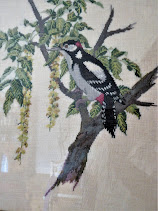
My wife was a keen embroiderer, as here:

Twitter comments:

  1. It's good and explains the day to day sheer grind well. Without self pity.
  2. Beautifully & gracefully written, Stephen.
  3. Thank you so much for sharing @stephenbigger. Spouse caring is honestly heartbreaking...it rips your soul in two. Welcome to an amazing grp of ppl who support each other online.
  4. We love to welcome fellow carers! Thank you so much for sharing your story Stephen x
  5. So hard for anyone not living the life of a carer to understand. You have my deepest respect Stevie and your wife is so very lucky to have you.
  6. Thank you for sharing this. It shows just because we call something a routine, the consequences, effects & experiences won’t always be identical. 
  7. What a great piece, Stephen! I'm so pleased you're still managing to find time and energy for your writing. I hope it wasn't me who spoiled the ending of Unforgotten for you, as (it's coming back to me now) I do recall I retweeted something from Sanjeev Bhaskar.
  8.  Very much so. With the usual dementias you get time to adjust to every "new normal" as a carer, but in Stephen's case it was an immediate plunge into the deep end. He's done (and is doing) astonishingly well. I'm in awe of him, really.


Friday, 25 December 2020

Creating the Old Testament: The Emergence of the Hebrew Bible (1989)


Creating the Old Testament: The Emergence of the Hebrew Bible.

Edited by Dr Stephen Bigger

Basil Blackwell Ltd, 1989. Available: print on demand.


Summary.

This book was put together as a contribution to school and university undergraduate courses since we felt that the subject had moved on from the assumptions of the previous generation which attempted to write a history of the ancient world on the basis of biblical texts. 

We know for certain very little about the history and times in which the Hebrew Bible (Old Testament) was written. But the books were written (by anonymous writers), the last, Daniel, being completed by the second century BCE. This book starts from what we know, that is the contents of the books and the apparent intentions of the writers where that can be surmised. In other books, the emphasis is on reconstructing history (always a parlous exercise) or expounding religious doctrine (be it for Judaism or Christianity). Removing these two agendas allows the texts to speak for themselves, often with surprising results.


Although the work of fifteen scholars, all connected with the Society for Old Testament Study,  it is designed to flow as a whole. It asserts no doctrinaire theological position and the different writers come from different faith and theological positions. It has one starting point: the Hebrew Bible was written by persons usually unknown, for a purpose largely unexplained. It emerged over time between 3000 and 2000 years ago; it was adopted as the Christian Old Testament, creating the idea of an old dispensation prior to the ‘New Testament’. That is our bottom line and we are interested in what they said and meant. Those writings have been used by Jews, Christians, Muslims and Baha'is in different ways and have caused both joy and conflict, freedom and oppression. In the interests of inter-faith dialogue, this literature has never been so significant. Religion is also in dialogue, or conflict, with secularity and it is important to break down barriers here also.


Understanding the issues in this book therefore are essential as we move into the 21st century.


Chapters.

1.      The Hebrew World.

2.      The Authority and Use of the Hebrew Bible in Judaism, Christianity, Islam and the Humanist tradition

3.      Symbol and metaphor

4.      Genesis: History or Story?

5.      Moses

6.      Covenant and Law

7.      The Former Prophets

8.      Jerusalem

9.      Stories of the Prophets

10.  Prophesy and the prophets

11.  After the Exile.

12.  The Psalms.

13.  The Wisdom Books.

14.  The Five Megilloth (Scrolls)

15.   The Other Books.


Note:  'AD' and 'BC. derives from early Christian scholarship, This dating-system is in common use in most cultures but, in the interests of neurrality, CE (Common Era) is used in this book to replace the Chrisrian designarion AD (Anno Domini, 'in rhe year of the Lord'), in accordance with the common usage in religious studies, BCE (Before the Common Era) similarly replaces BC (Before Christ).


Introduction

The concept of 'Old Testament', the old covenant as contrasted to a newly emerging covenant, emerged before the Christian era. The prophet Jeremiah saw the possibility of a new covenant written on the heart, a spiritual faith in which all will know God. It would replace the Sinai covenant made after the exodus from Egypt, which had been broken so often and so completely. Greek translations preferred the word 'testament' (diatheke) to 'covenant' (suntheke), perhaps because 'testament' left the initiative in God's hand, while 'covenant' suggested a relationship of mutual influence.


Paul - a Jew, and a Pharisee turned Christian - spoke, in a vein similar to Jeremiah, of the Torah of Moses as the old 'testament' or covenant, a written code which kills, a 'dispensation of death, carved in letters on stone' (2 Corinthians 3.6-16). Its injunctions were so far-reaching that no one could hope to obey them perfectly, and all must live with their failure and its im­plications. The early Church regarded the Hebrew Bible as scripture, often quoting it as an authoritative text. Melito of Sardis (died c.190 CE) and Tertullian (c.160-225 CE) are the first known writers to call the books 'Old Testament' - the first in Greek, and the second in Latin. By the third century CE, Christian writers had begun to contrast the Hebrew Bible with the New Testament writings, often with pejorative overtones, to create the impression of a group of archaic books, of little value except for Messianic prophecies foretelling Jesus's mission - that is, to create the idea of an Old Testament which looked forward to the coming of Jesus and Christianity, preparing the way for something better. The contributors to this volume wish to allow the Old Testament writings to speak for themselves, helping the reader to understand what they are trying to say, and to appreciate the books for what they really are.


The books of the Hebrew Bible were created by anonymous writers during the first millennium BCE. Their messages and concerns are the central theme of this book. Ours is the story of how the writings which make up the Hebrew Bible emerged from their mouths and from their pens as expressions of their great creativity, interpreting life as they saw it and conveying meanings they glimpsed. Others appreciated their ideas, preserved their words, and developed their teaching, sometimes in new directions. It is easy for readers to get lost in the minutiae of biblical criticism, interested for so long primarily in historical reconstruction; but this book encourages those who will, to listen to the words themselves with an open mind, and to allow the messages of the Hebrew Bible to emerge once again after centuries of Christian interpretation, which has been selective in its concerns and has obscured by reinterpretation some of the in­trinsic value of the Hebrew books. The Christian dimension is not unimportant - but it is a secondary dimension, involving reinterpretation, and should not blind us to other perspectives.


This book is not an introduction to the books of the Hebrew Bible, nor yet another history of Israel. It is, in essence, an exploration, inviting the reader to set off on an expedition of discovery. It often perplexes the general reader that, on virtually every issue in the study of the Hebrew Bible, scholars disagree, often fundamentally. In this book, issues are raised and explored to enable the reader to observe how decisions are made, on what evidence, how hypotheses are formed and how the so-called 'assured results' of scholarship are constantly tested. In following this path, readers are encouraged to develop their skill in evaluating historical data, recognizing textual problems, interpreting symbolic language and exploring the deep concerns of the biblical writers. They will explore different and varied exegetical traditions. They will be stirred to reflect on what the biblical books have to say for life today, whether viewed from a Jewish, a Christian, a Muslim or a secular perspective.


The fundamental aim of this volume on the Hebrew Bible is encourage readers to understand the text and its implications. Since the text was handwritten, mostly in Hebrew (some portions are in Aramaic) we need to explore whether the text has been accurately transmitted. For example, 1 Samuel 13.1 notes that 'Saul was son of one year when he became king, and he ruled over Israel for two years.' The Revised Standard Version assumes that the numbers have dropped out and leaves a gap; the New English Bible somewhat cavalierly inserts numbers from guesswork; Saul becomes fifty years old, and reigned for twenty-two years! The early Greek translation, the Septuagint, also had trouble with this verse, so the corruption had taken place at a very early stage. There seem also to have been different families of manuscripts with different readings. The 2000-year-old texts found near Qumran (the so-called Dead Sea Scrolls), differ in very many respects from the Hebrew text used as the basis of English translations - which is scarcely 1000 years old. Sometimes the New Testament, when quoting a passage from the Hebrew Bible, differs considerably from the Hebrew text that we know (compare, for example, Acts 15.17-18 and Amos 9.11-12). Another question to be asked is whether we should understand passages literally or symbolically. Augustine of Hippo, writing in the fifth century CE, looked for solutions to problems raised for example by Genesis 1-11, where we find great ages, sons of God and giants. The Jewish philosopher Moses Maimonides (1138-1204) explained problem passages in the light of the world as he knew it: miracles and supernatural events must have rational explanations! Both writers recognized descriptions of God as metaphor - God has no body or emotions, and is beyond human understanding.


In studying the Hebrew Bible, we spend most of our time reflecting on a wide range of interpretation, rather than on the text itself. A translation is itself an interpretation which selects one line of thought: the original writer would have been acutely aware of the wide range of meanings in a word and intended these to interact. There are also traditions of modern interpretation which are hard to break through: notably the Hebrew Bible is viewed from the standpoint of Christian theology, which can blind the reader even to the obvious. Detailed interpretation of the text is called exegesis - drawing out meanings and interpretations. In the Jewish tradition the same general process of interpretation is called midrash.


No interpretation of any text is 'just a matter of opinion'. To reach an informed view, the. reader has to develop a careful methodology. D. J. A. Clines describes these (in Rogerson, 1983: 26-43) as 'first-order methods', dealing with our understanding of the text; and 'second-order methods', using the text for other purposes, such as historical reconstructions. His first­order methods are


·         historical-grammatical criticism: to discover the natural sense of a text, for the authors in their own time;

·         textual criticism: to examine the original texts, and in so doing seek to resolve problems of detail;

·         redaction criticism: to examine the literary artistry of the writers (called here redactors or editors), and to discover why a work has been constructed in the way it has been. (This is sometimes called literary analysis or literary criticism.)


His second-order methods are


·         historical criticism: using the text to reconstruct, as far as possible, what actually happened.

·         source criticism: examining sources if known and reconstructing hypothetical sources behind a work.

·         form criticism: reconstructing the (now lost) oral process, and the hypothetical oral layer underlying a text.


Priority has often been given to these 'second-order' tasks, alongside historical-grammatical commentaries. The interest in literary questions ­of a text’s flow and artistry - is relatively recent. Robert Alter (1981, 12f) argues that the major emphasis in biblical studies had been 'excavative', ­searching the text for data about history - with astonishingly little interest in developing a disciplined way of studying the text itself, as one might with Shakespeare or Tolstoy. Literary studies have mushroomed over the past decade, and Alter's work is now viewed as 'pioneering'. R. Polzin (1980: 5), in agreeing with Alter, called the results of historical­-critical analyses of biblical material 'disappointing and inadequate'. The present work strikes a balance between literary and historical methods, in the belief that each is essential to the task of developing our understanding and appreciation of the texts of the Hebrew Bible.


The divine name in the Hebrew Bible is written with four letters, YHWH, which Jewish readers have traditionally read as Adonai ('my Lord') in case the divine name is uttered 'in vain' - so contravening the third commandment. Attention here is focused on the dangers of insincerity. In Hebrew YHWH is vocalized with the vowels Adonai, reminding readers to make the replacement: this produced in English the hybrid name 'Jehovah'. To find the appropriate vowels, scholars went to eatly translations and transliterations (e.g. writing Hebrew in Greek characters). Critical works normally refer to the Israelite god as Yahweh, or God if the reference is more general. This convention has been followed in this volume because of its wide audience; Jewish readers are asked to bear with this usage and make their own mental adjustments. English translations generally replace Yahweh with 'the LORD' and this too has been followed in biblical quotations.


Thursday, 3 October 2019

Dialogical Self Theory (DST)

 © Stephen Bigger 1st October 2019

I have just positively reviewed a symposium of papers on moral and spiritual leadership in the series Studies in World Christianity and Interreligious Relations. 13 papers make up Moral and spiritual leadership in an age of plural moralities, edited by Hans Alma and Ina ter Avest. The papers stemmed from a conference for religious education and religious studies staff on Leadership in the light of Zigmunt Baumann’s ‘liquid modernity’. The review appears in print in the Journal of Beliefs and Values early in 2020 and online here. I present in this blog some introductory and additional material.

Its subject matter covers a range of topics, not all on leadership and spirituality. Spirituality seems to mean having relevant to a Christian theme, though 'inter-religious' has a broader reach including what is called 'worldview'. Its key themes link moral education with dialogic self theory. The history of dialogue drew on William James (1890), Martin Buber (1923, ET 1970) and Mikhail Bakhtin (1929, ET 1984). Dialogical Self Theory (DST) was the major research interest of the author of chapter 2, Hubert Hermans who co-edited two handbooks exploring it, in 2012 and 2018. DST, which is used in Psychoanalysis,  the self as relational (a continuous dialogue between ‘I’ and others) and dynamic (constantly modifying). It speaks of a variety of ‘I positions’, that is versions of ‘I’ in different circumstances. The ‘self’ is not an entity but a mix of different understandings and instincts, begun in earliest childhood before language. DST speaks of the ‘society of mind’ for this mix of ‘I positions’ which make up our inner dialogue. Inner voices are influenced by the past (things we have heard or read) and influence the future. Psychotherapy using DST patiently unravels conflicting thoughts/living contradictions.

James and Buber spoke of relationships, I and You / I and Thou. Relational morality and relational leadership provide the book’s starting point. Bakhtin contrasts dialogue with monologue, on which his critical theory is based. He wrote with a circle of friends in the 1920s but Stalin’s rule presented life-threatening dangers. Medvedev was shot by Stalin,Voloshinov died of TB, Bakhtin was exiled. Though it is widely assumed that Bakhtin was co-author, it may just have seemed safer for the named author to be dead.  The early works on language viewed language as social utterance to others expecting a response. This essay might be a monologue, its author, me, just arranging words. But the words are to an implied audience, you, who are able to comment in response. Moreover, my (the author’s) understandings are influenced by what I have experienced, learned, heard and read. This adds up to language being social and dialogic. Nevertheless it may be dressed up as a monologue (one person talking) and in a sense the all-knowing authorial voice in a story or novel operates as though a monologue.

Writing at this very dangerous time, Bakhtin used a study of literature as his next starting point. He hid his general philosophising within studies of Homer, Dostoevsky, and Rabelais. With Homer it was author and hero. He argued that Dostoevsky, using various narrators rather than an all-knowing narrator, is heteroglot (heteroglossia, various voices), not monologic (one voice). The Stalin era was essentially monologic, with everything defined and stipulated from above by one totalitarian person. His study of Rabalais described carnival, whose import I am not concerned with here.

Bakhtin was a member of the Russian Orthodox Church, but needed to re-express his Christianity in secular ways.  Ruth Coates (1998) follows some threads in Christianity in Bakhtin: God and the Exiled Author, in what she says is a neglected field, stressing that Bakhtin was not a theologian so her analysis simply shows his influences. Indeed Bakhtin was always reticent about his personal history, silent on how God and conscience fits into his discussion. That he was arrested and exiled as a member of a religious discussion group is pertinent. It is his contribution to secular philosophy that is most commonly discussed. Maybe behind the emphasis on author and hero we can see God and humanity, humans written and controlled by an overseeing voice who knows the end from the beginning. Coates examines the following themes: the fall (sinfulness); salvation, incarnation, God, man (humankind), new birth, eternal life, hope, and love. Dialogue is between people. Humans are part of an eternal chain of dialogue so in a sense individuals live on through their slots of influence, their provocations and responses. This is secular eternal life/influence. The contrast between free will and predestination (lives controlled by higher forces) was always a theological conundrum.

Dialoguism declares that people are part of a never-ending chain of provocation and answerability so free will cannot exist. We and our ideas are fertilised by the dead (Bakhtin, 1984: 404). This vision is mystical (rather than pragmatic) and assumes a human world that is social rather than individual, and dynamic rather than static (Matusov and Marjanovic-Shane, 2017). On education they emphasis (p.71) that students/learners are active and not passive:
We think that the teacher’s pedagogical authorship has to be subordinated and to serve to the students’ own educational authorship. It is the students’ own diverse problematics, which is important and not the teacher’s one.
and
Holism in education is deadly and oppressive. Students are not idea-characters of the teacher’s polyphonic pedagogical authorship but rather are full-fledged authors of their own education, ideas, and life. Pedagogical responsibility and authorship of the teacher should be aimed at supporting the critical authorship of the students, as the students wish it, – ultimately education cannot be forced. (p.72)
Dialogical Self Theory (DST) covers inner and outer dialogue, but its use in psychoanalysis emphasises the inner, where our sense of self is multi-voiced (polyvocal) built up of provocations (things we have heard or read) and answers/responses by ourselves and others. These produce what DST calls ‘I positions’ which mingle in our minds to produce ‘a society of mind’. Thus our ‘self’ is viewed as a community in dialogue, maybe a peaceful discussion, maybe a cacophony. I am taking some points from Hermans and Gieser’s Handbook of Dialogical Self Theory (2012). DST is described as a bridging theory, bringing together a range of other insights and disciplines, “theories, research traditions and practices” (2012:1). In this period promoting the rights and ambitions of the individual, relational and dialogical agendas place the individual in community. The self, ’I’ is part of a social chain,working together for the common good. The whole is “a dynamic multiplicity of I positions” as the ‘I’ makes social connections. These positions vary temporally (over time) and spatially (across contexts), even changing dynamically as a consequence. Some I positions are dominant, 'promoter positions'. There are 'taboo positions' also (p.93). I positions might fixate into multiple personalities. The self in the real world is involved with people and events; but also DST views similar dialogues happening in the head, which is where the link to psychotherapy comes in, to work out how different experiences, relationships and ideas interact in our heads. We position ourselves in particular ways and even re-position ourselves in the light of new insights. Some DST research favours complex questionnaires (e.g. the personal position repertoire), tending to be positivist; others use broad qualitative interviews and even psychodrama.

The overall conclusions were that leaders need to be relational, encouraging dialogue and able to respond to unexpected circumstances. The same is true of all personal relationships. Leaders can be autocratic and, in DST terms, monologic, i.e the leader sets the agenda without discussion. Their followers are expected to be obedient without owning the reasons for their compliance. DST has an interest in education too, the contrast between monologue and dialogue being particularly appropriate. Teacher monologue can come as talk, worksheet of textbook. Dialogic pedagogy has high regard for relationship and discussion, with an emphasis on teachers and their students being co-learners.


Sean Warren and I (2017) contrasted relational pedagogy with authoritarian monologic teaching based on almost a decade of discussions around his PhD. He promoted discussion and thinking skills based on adult to adult relationships as opposed to what he had identified in his own previous overbearing parent to rebellious child strategies that he inherited from his own schooling. He chose the title Living Contradiction  to emphasise his inner unhappiness with both his pedagogical inheritance and current demands for authoritarian policies. There is a better way.

This volume focussed on religion and spirituality, also called more neutrally as 'world view'. Dialogue should mean open ended discussion but appears in the book as combative, as though people of fixed views could not agree. This is true to some extent as people believing that their faith is the only truth would find it hard to discuss with people of other faiths. My experience of the Religious Education Council showed that there were tensions. In inter-religious contexts, dialogue is normally between people of fixed mindsets, with little if any openness. This is not a criticism but an observation. The nature of religion is baseless ideological certainty, a conservative monologue, with no dialogue except in silos. Inter-religious 'dialogue' is entered into with the hope of changing minds so is not dialogue in Bakhtin's sense. It is in a sense adversarial, seeking both to persuade and diminish. Maybe belligerently so. To  be fair, each side may try to find some common ground, via ethics maybe, but that self-selects people who value that, cutting out extremists who are beyond compromise.

I am an atheist who studies religion and speaks without belligerence to faith members and with respect. I make it clear that I am not trying to change minds and am not seeking to be converted. That can sometimes lead to dialogue. There are other positions that impede dialogue, such as misogyny, racism, disrespect for others, assumptions of superiority and so on. Here an interchange might involve a protest, a calling out, an alternative point of view. It may not rank highly in the chain of utterances since the difference of opinion is likely to be unresolvable.  Twitter is full of such dialogue cul de sacs.

Since the book reviewed was by scholars of religious studies/education, I have other pertinent observations. I am reading Bakhtin and genre theory in biblical studies (ed.R Boer) which, even though the Bakhtin content is superficial, points to further lines of inquiry and the papers are interesting. Some writers had worked with genre before so a Bakhtin dimension added little. Some used dialogue loosely so genres in dialogue was little different from intertextuality. I don't intend to review the book here, but instead apply some thoughts to Biblical Studies. Bakhtin was a Christian in the Russian Orthodox tradition. Involvement with a Christian group may have been one of the factors in his exile.It became clear that theology had to be expunged from his writings for safety's sake. Ruth Coates (1998) traced some Christian attitudes through his writings. These include incarnation, the fall, love, Christ, sin, salvation, and transcendence. Are there parallels between the author and the hero and God and people, God and the author each holding power over his creation? In general, Bakhtin emphasises polyvocal authorship with many voices in evidence with corresponding ambiguity and conflicting voices. The important starting point is that the Bible is not monologic. There are many voices behind and within its many books. There is an attempt to claim authority by representing texts as divine words, which is of course a fiction. There are persuasive attempts to justify myths about origins and land claims. The reader has to learn to recognize these voices and their political. They are mainly male voices. Female voices have been muted, as recognized by Cheryl Exum in Fragmented Women. As with Homer, there are issues about which an epic narrative had an oral prehistory -  or not. And there are certainly issues about whether heroes are exemplars to follow or to avoid. So the Bible interpreter could get rich rewards from a study of Bakhtin, as Robert Polzin did in his study of the Deuteronomic History (Polzin 1980, 1989, 1993). Inspired by Bakhtin's study of Dostoevsky, he attempted to approach Old Testament narratives in the same way, as literature written by authors with artistic talent. As more Bakhtin works were published in the 1980s (some listed below), Polzin was able to deepen his analysis, though the readers will need to examine the footnotes carefully. Afar as I can tell, volume 4 on Kings was never completed. Polzin's voice can be heard in dialogue with the authors and editor of Boer's collection.  This is how dialogism works as an agenda is carried through to the new generation. He had remarked that we do not impose Bakhtin on a text but all the text to speak for itself through the lens suggested by Bakhtin. So what are the  points of view of the narrator, the author, later editors, translators, characters in the story? Similar narrative analysis was being carried out by Robert Alter, soon to produce The Art of Biblical Narrative (1981).These approaches make no assumptions as to whether the genre was fiction, or historical fiction/faction. Rather they uncover the artistry. This also uncovers the different voices contributing to the whole which might once have been blamed on editors and redactors. Bakhtin called this polyvocal and the existence of conflicting voices heteroglossia. Polzin defends the shift from historical (diachronic, 'across time) to literary (synchronic, 'viewed from a specific time') in the opening chapter of Moses and the Deuteronomist (1980).

In summary, Polzin's work emphasises that the Bible narrative is not a monologue but a collection of many voices. The authoritative (persuasive) voice may be that of the author but the narrator also has a dominance which might conflict. Thus the death of Saul is narrated as suicide but later claimed by an Amalekite boy who is killed for his claim. Who is right? and where does the propaganda lay? The conjunction may have been designed to place uncertainty in the ancient readers' minds. 'real thematic finalization is impossible' (Medvedev/Bakhtin 1928) as it has a prehistory and a posthistory. The first step is its setting in real time and real place, termed in Bakhtin studies as chronotope. Hence my interest, and Polzin's, in who authored the biblical narratives, at what time, with what artistry and for what purpose.

References

  1. Alter,Robert. 1981. The Art of Biblical Narrative. New York: Basic Books.
  2. Bakhtin, M. M. 1981The Dialogical ImaginationAustinUniversity of Texas Press
  3. Bakhtin, M.M.  1984. Problems of Dostoevsky's Poetics. Translated and edited by C. Emerson. Minneapolis,MN: University of Minnesota Press.
  4. Bakhtin, M. M. 1986Speech Genres and Other Late Essays. Translated and edited by V. W. McGee. AustinUniversity of Texas Press
  5. Bakhtin, M. M. 1990Art and Answerability. Edited by M. Holquist and V. Liapunov. Translated by V. Liapunov and K. Brostrom. AustinUniversity of Texas Press. [written 1919–1924, published 1974-1979]. 
  6. Bakhtin, M. M. 1993Toward a Philosophy of the Act. Edited by V. Liapunov and M. Holquist. Translated by V. Liapunov. AustinUniversity of Texas Press.
  7. Bauman, Z. 2000Liquid ModernityCambridgePolity Press
  8. Bigger, S. F. 2009. “Victor Turner, Liminality, and Cultural Performance.” Review Article of Victor Turner and Contemporary Cultural Performance, edited by Graham St. John. Journal of Beliefs & Values 30 (2): 209212. doi:10.1080/13617670903175238
  9. BoerR. (ed.). 2007. Bakhtin and gender theory in biblical studies. Atlanta:Society of Biblical Literature, Semeia Studies 63.
  10. Buber, M. 1923. Ich und Du; also in 1954 Die Schriften über das dialogische Prinzip (Ich und DuZwiespracheDie Frage an den EinzelnenElemente des Zwischenmenschlichen). ET with introduction and notes by Walter Kaufmann, I and Thou 1970.
  11. Carens, J. H. 2000Culture, Citizenship, and Community: A Contextual Exploration of Justice as EvenhandednessOxfordOxford University Press
  12. Coates Ruth 1998. Christianity in Bakhtin: God and the Exiled Author. Cambridge: Cambridge University Press. 
  13. Connolly, W. E. 2011A World of BecomingDurham, NCDuke University Press
  14. Exum, J.Cheryl. 2016 Fragmented Women: Feminist (Sub) Versionsof Biblical Narratives, 2nd edition.London/New York: Bloomsbury/T&T Clark.
  15. Hermans, H. J. M., and T. Gieser2012Handbook of Dialogical Self TheoryCambridgeCambridge University Press.
  16. James, W. 1890. The Principles of Psychology. Revised edition 1918.
  17. Johansen, B. 2009Leaders Make the Future: Ten New Leadership Skills for an Uncertain WorldSan Francisco, CABerrett-Koehler Publishers Incorporated
  18. Johansen, B. 2017The New Leadership Literacies: Thriving in a Future of Extreme Disruption and Distributed EverythingOakland, CABerrett-Koehler Publishers Incorporated.
  19. Konopka, A.H. J. M. Hermans, and M. M. Gonçalves2018Handbook of Dialogical Self Theory and PsychotherapyAbingdonRoutledge
  20. Lederach, J. P. 2005The Moral Imagination: The Art and Soul of Building PeaceOxfordOxford University Press.
  21. Matusov, Eugene & Marjanovic-Shane, Ana. 2017. Bakhtin’s mystical organic holism and its consequences for education.  Dialogic Pedagogy: An International Online Journal  Vol. 5.
  22. Medvedev, P.N.  (=M.M. Bakhtin). 1928. The Formal Method in Literary Scholarship, trans A, Wehrie, Baltimore:Johns Hopkins.1978
  23. Polzin, Robert. 1980. Moses and the Deuteronomist: A Literary Study of the Deuteronomic History, part 1, New York: Seabury Press
  24. Polzin, Robert 1989 Samuel and the Deuteronomist: A Literary Study of the Deuteronomic History, part 2, 1 Samuel. San Francisco: Harper & Row
  25. Polzin, Robert 1993 David and the Deuteronomist:  A Literary Study of the Deuteronomic History, part 3, 2 Samuel. Bloomington: University of Indiana Press.
  26. St. John, G. 2008Victor Turner and Contemporary Cultural PerformanceNew YorkBerghahn Books.
  27. Turner, V. W. 1982From Ritual to Theatre: The Human Seriousness of PlayNew YorkPAJ Publications.
  28. Warren, S., and S. Bigger2017Living Contradiction: A Teacher’s Examination of Tension and Disruption in Schools, in Classrooms and in SelfCarmarthenCrown House Publications.


Sunday, 9 June 2019

Malcolm Saville, White Fire 1966

I am writing introductions to the reissues of Saville's Marston Baines Series republished by Girls Gone By Publishers. We have got to book 4, White Fire set on Mallorca following a family holiday which comes out in August 2019.

The Marston Baines Series for young adults took inspiration from James Bond novels and films, replacing gratuitous sex with innocent romance. Saville in his latter years was ever hopeful that the Marston Baines series would come into paperback for wider distribution, but they did not do so then. He intended them to be stories of good versus evil, never ambiguous or nuanced. White Fire, the fourth story (Heinemann, 1966, 180 pages) was the result of a family holiday on Mallorca in April 1964. The title uses the name of a large smuggled raw diamond. It loosely followed the theme of Ian Fleming’s Diamonds Are Forever (1956) about ‘blood diamonds’ smuggled from Africa in a trade littered with bloodshed and criminality. Fleming also wrote a factual account The Diamond Smugglers in 1957 which as an interesting background of its own and Saville had clearly read. The Bond film of the book was still in future (1971) and stimulated the writing of the sixth Buckingham story Diamonds in the Sky (1974) set in Amsterdam. White Fire has always been a hard-to-find title since there was no CBC (book club) edition. There were no serious reviews in the media.

The Foreword reveals another Saville bête noir: “Industrial diamonds are used for machine tools, and are essential for the manufacture of armaments. Recently China has been in the market for them” (p.viii). According to his late son Robin, Saville never ceased to be agitated about China’s global ambitions. Mao’s declared objective was to overtake Britain in steel production by 1968 through a programme called ‘the great leap forward’. At the time of writing, 1965, this is what Saville is referring to. He need not have worried: taking people away from farming to produce steel inefficiently led to mass starvation, resulting in millions of deaths. Between 1966-8 came the purge of critics and potential critics (the intelligentsia) in the repression known as Mao’s cultural revolution. China was considerably knocked back by both these.

Marston Baines is a thriller writer, but also a secret service operative, living in Sussex, handled by ‘XB’ out of frequently changing secret offices. His appearance is not Bondesque, but “stoutish and loosely built” with thinning hair and horn-rimmed spectacles, wearing a tweed suit and hat, reminiscent perhaps of Sherlock Holmes. He “shambled”....  The story also features Marston's nephew Simon and a tough girl of romantic interest Rosina. Simon and Rosina appeared in French translations of the stories where they are less happily named Stanley and Carol.

To read on, and the story itself, order from the publisher's website. Details of the previous title, Dark Danger can be  found here

Tuesday, 11 December 2018

WW2 Women Fliers in Fiction

Women Flyers at War: W.E. Johns and Dorothy Carter, Worralls and Marise.

by Stephen Bigger, Conference Paper, Bristol 2018

Thank you for the opportunity of writing this paper and my apologies that I cannot be with you in person because of my responsibilities as lone carer. I have had a research interest over the past three decades in stories written for children between 1939 and 1945, a time when no one knew how the war was going to turn out. Evacuation was occasionally mentioned as a topic, but apart from Kitty Barne’s Visitors from London using her WVS evacuation experiences, the evacuation stories we know best were written later. Barne’s other war stories We'll Meet in England (1942, refugees), Three and a Pigeon (1944, black market), and In the Same Boat (1945, sinking ships) have been neglected as their war context has retreated.
I focus this paper on female fliers in fiction in this period. The 1930s had charismatic examples of female pilots such as Amy Johnson which gripped the popular imagination. Mary Cadogan wrote Women with Wings: Female Flyers in Fact and Fiction (1992), linking history with fictional stories. I am going to deal with two examples she mentions there, the Worralls books by W E Johns, which I shall cover in broad outline only since Mary gave a reasonable summary, and I offer a fuller discussion of the war stories of ‘Dorothy Carter’ (pseudonym of Mrs Dorothy Eileen Heming nee Marsh).

Worrals

W.E Johns had his own experience of flying in wartime in the Royal Flying Corps and those primitive aircraft are never far from his Biggles stories. He kept up to date through his Popular Flying and Flying magazines, and he supported Churchill in the call for rebuilding the RAF in the 1930s. He received a favourable supply of paper during war years and was asked to encourage girls into flying careers. With women being recruited into the forces, the government were keen to motivate girls and women to join up. The Worrals books were a consequence of this. Flight Officer Joan Worralson (Worrals) of the WAAF had a friend Betty "Frecks" Lovell. He was not securely briefed. WAAFs did not fly (though Worrals and Frecks did) but did admin tasks. Women in the ATA transported planes from factory to airfields. Worrals did an SOE operation without her author having any clue of SOE training and operations. Johns knew Amy Johnson (married name Mollison which the name Worralson mimics) and former stunt pilot Pauline Gower, who established the women’s branch of ATA (Air Transport Auxiliary).

The wartime Worrals books took her to France, Mesopotamia and Australia. The factual basis was loose. WAAFs did not fly planes but Worrals flew a ’Reliant’ (clearly based on a Boulton & Paul Defiant). Frecks uses the gun turret in anger, another forbidden action for a WAAF. Two SOE style missions to France are a stretch of the imagination too close to the truth for comfort (SOE was a secret organisation). Maybe that is why he was encouraged to send Worrals and Frecks further afield, to the Middle East and Australasia. Johns was not paid well for his books so he wrote a lot. A chapter before breakfast, he claimed, a new book in three weeks. Worrals was rather like Biggles with a bra, with similar daring do, but going weak at the knees when with her beau. His representation of women would not have impressed Pauline Gower.
Dorothy Eileen Marsh/Dorothy Carter (Mrs Heming), 1901 - 1948. 

My first introduction to Mrs Heming’s books was through a recommendation to read Dorothy Carter’s Wren Helen (1943), named after Eileen’s daughter and grandmother or greatgrandmother of living family members. I was fortunate to correspond with members of her family and with their help listed and purchased her books. The 1930s depression was hard on the Heming family, with four young children to feed and clothe. Eileen had a typewriter and could type well. Writing books was a possible way out. School stories were popular, boys playing cricket, girls hockey. Jack Heming heard in the mid 1930s that stories of flying would sell, so the couple went up to London to talk to W E Johns, then a publisher. They came back enthused and began to plan books on flying, but without particular expertise in aeroplanes. Not all were happy politically. In Blue Wings, Jack places his heroes on the side of the Nationalists (Fascists) against the Republicans (democrats) who are stereotyped as vicious Soviets. It is a lively story, but doesn’t read well today. Mrs Heming opted to use different pen-names for different audiences (and publishers). Her family helped me unravel them, as they also helped Eric Bates to produce a privately printed (now unavailable) biography/bibliography Among Her Own People: Lives and Literature of Eileen Marsh, Jack Heming and Bracebridge Heming in 2005. Until my 2009 blog entry (in 1930-1960.blogspot.co.uk), booksellers were unaware that her pen-names were linked.
In Wings in Revolt (1939) she as Dorothy Carter includes a Captain Bigglesworthy, a humorous allusion that seems not to have annoyed her mentor. Mary Cadogan had an advantage on me in being able to use the British Library, whilst I had to seek out and buy the very scarce books. This paper focuses on Eileen’s war stories involving women fliers. Mary Cadogan, Women With Wings, ch. 7, pp.130-5 wrote:
“Efforts to find out more about Dorothy Carter, as a pilot and a writer, have proved abortive – but she was certainly one of the first authors to create really convincing flying stories for girls” (p.131).
By 2010 both judgements were incorrect and Mary and I met several times to discuss issues dealt with in this paper. Mrs Heming had no substantial flying experience, and was vague on details. The books also puzzled Owen Dudley Edwards in his study of second world war youth literature. I met and corresponded with Owen around 2010 and I introduced him to Bates’ book and the contents of this paper.

Eileen Marsh contributed to the Girls Own Paper (GOP) encouraging upper-middle class girls to learn to fly. From 1935 she wrote 102 books until her early death in 1948 (average 10 a year, one every five weeks) under many names. 25 were about female fliers. She often combining her real names Dorothy Eileen Heming (nee Marsh) or using other family names. She published 7 titles in 1936, 4 as Eileen Marsh, and one each of Dorothy Carter, Martin Kent and D.E. Marsh. Of the twelve titles in 1937, 5 were by Eileen Marsh, 2 by D.E. Marsh, and one each by James Cahill, Guy Dempster, Martin Kent, Elizabeth Rogers and E M Shard. And so one, year by year.

Altogether by 1948 there were 26 books by Eileen Marsh, 14 by Dorothy Carter, 9 by Elizabeth Rogers, 8 by Guy Dempster , 6 by Martin Kent, 6 by D.E. Marsh, and smaller numbers for the rest. After the war, when paper was more plentiful, she also wrote Sunday School prizes for Lutterworth, (a lucrative market) using the names Eileen Heming, Dorothy Marsh, James Cahill, Rupert Jardine, Jane Rogers and Mary St. Helier. Male or neutral pen-names were used for boy readers, and different publishers monopolised particular names, such as Collins with Marise titles, and Lutterworth with Eileen Heming titles. Guy Dempster books were blood-curdling Fleet Air Arm stories for boys, following troops in the armed service, maybe in collaboration with Jack who was away in the war. As Elizabeth Rogers, The Girls of Fort Tregantle (1946) was a romantic romp on an ATS training exercise, with the preoccupied girls giving too much away to a pair of German-Irish spies. The hot hormones wouldn’t pass any feminist test today. Her 15 adult novels, most as Eileen Marsh, offered a social commentary on the 1940s. These books are war related and of good quality. We Lived in London (1942) was a hard-hitting account of life in the blitz. The Walled Garden (1943) began a family saga. Eight Over Essen (1944) followed the lives of eight members of a bomber crew who failed to return from an Essen raid. I Had a Son, Barbed Wire and The Memorial showed social tensions.

Both Mary Cadogan and Owen Dudley Edwards praise the stories as giving an authentic picture of flying and presume Eileen was a flier. She was not. Her first two flying books, written in 1935, were Two Girls on the Air Trail and Peggy Parachutist in which details of how to fly were imaginative, such as managing to throw a small packet from the plane into an open window. Radio tuning is usually described as ‘twiddling the knobs’. When books began to sell and she had some spare cash, she took a few short lessons to get a sense of what dials and knobs did. She read first-hand accounts of flying and probably talked to pilots. The series we are mainly dealing with during the war are of Marise for Collins writing as Dorothy Carter. There were post-war flying stories focusing on a new heroine Jan.

The first three Marise books are implausible accounts of winning the Kings Cup Air Race, being in the movies and being taken for a goddess in the snowy Arctic. The three next titles concern us here:

Sword of the Air (1941)

Comrades of the Air (1942)

Marise Flies South (1944)

Marise has a plane in Croydon Airport and as Sword of the Air opens, the second world war will be announced next day, her father being in the secret service getting people out of Poland. Marise meets up with her father in between trips. Marise applies to join the WAAF (or WAFF, p.20) but is rejected but later invited to join the ATA as a ferry pilot, taking new planes from the factory to airfields. She is interviewed by a tall lady resembling Pauline Gower who developed the female section of ATA. Gower’s autobiography Women with Wings inspired Mary Cadogan’s title. Amy Johnson was one of her early recruits and died on an ATA mission. The casualty rate was one in ten, but these were the glamour girls. Marise’s first posting was to a Hawker ‘shadow factory’, presumably that built on Parlaunt Farm, at Langley near Slough developed in the late 1930s. She overcomes chauvinist banter with aplomb. Her first delivery was of a Hurricane to a camouflaged airfield (invisible from above). There was indeed a camouflage unit to deceive hostile aircrew, but such work was uncommon in 1940 when the story was set. Delivery of a four-engined seaplane to the east coast for Coastal Command gives the opportunity to describe convoy operations operating with radio silence. She begins to meet her male chums from previous adventures ‘doing their bit’. She delivers a Spitfire to pre-Dunkirk France (therefore before late May 1940) where she met two more male chums. The airfield was probably Calais Marck. The Spitfires delivered here were reconnaissance, and the story confirms that this is what her chums were doing. On the next trip her plane was lost in fog and strayed over German territory, brought down by flak, which following orders she set on fire. She hatches a mad plan to steal a Messerschmitt 109 but was apprehended. On hearing the news chum Jim went into action. Marise felt that ordinary German soldiers were kept in the dark by propaganda, whereas the SS were ‘scum of the earth’ and ‘scum rises to the top’. Her guide on the journey to Berlin tried to discover if she was a spy. She was kidnapped, and counter kidnapped by the resistance so meeting her father again. With no easy way home, Marise became ‘Magda’ cousin of an SS man working secretly with the Resistance, and sent to work in an aircraft factory. When compromised (with prime information) she and her father were spirited away home by the three chums in a night landing of a Wellington bomber.

The following year came Comrades of the Air, in which Marise discovers that her three male chums were going to Russia (shortly after Barbarossa, the Nazi invasion of Russia has begun). She persuades her ATA boss (Pauline Gower in real life) to let her deliver a plane to Russia. Details of the improbable journey over German occupied territory are vague. She meets up with Russian female pilots and in particular Katya Petroff. The Soviet pilots shoot down several Nazi planes before having to close down their base in the face of enemy advances. Marise flies a ‘sweet to fly’ Russian bomber (Mary Cadogan surmises a Tupoler SB-2, actually a Tupolov ). More likely it was a Petlyakov Pe-2. Eileen was a keen reader of aircraft magazines and rejoiced in new developments. Tupolovs comprised 95% of the Russian Air Force, but it was not remotely sweet to fly, quite the opposite. By 1940 it was largely obsolete though a few late marks minimised some problems. It was nicknamed Pterodactyl because its high wings were ungainly. Petlyakov was Tupolov’s deputy and set to work to design a new type which entered service around 1940. The Petlyakov Pe-2 was a high-altitude twin engine bomber what came into service in 1941 and were largely flown by women pilots. It was heavy on take-off, often a two-woman job, but after that it was sweet enough to fly. It was well-defended, more so over time and from the beginning was a match for Bf109s (although gunner casualties were high).
There are various escapades, the plane losing navigation devices and ending up at the arctic coast, Marise using her Canadian arctic skills to repair the engine, witnessed a naval war-crime, and eventually returning to habitation to find Nazi forces committing atrocities which we now know was not propaganda. Her three male chums turn up with her father, and they all overcome all odds. The story of the Soviet women pilots has been honoured in several books, listed below. Wherever Eileen took her information from, she told this story with deep respect.
The final Marise wartime story, Marise Flies South (1944) sees her ferrying a plane to Darwin, Australia and New Guinea. The Australian formula was similarly used after the war for Jan (Janice) and Wren Helen. Marise takes a B24 Liberator bomber to Darwin single-handed and is invited by two other female ferry pilots to take Typhoon aircraft to New Guinea. The story was undoubtedly suggested by the exploits of the B24 ‘Shady Lady’, from the 380th Bombardment Group, “The Flying Circus”. Darwin was bombed more severely than Pearl Harbour in 1942. Eleven Liberators attacked a Japanese fuel refinery on Borneo. Shady Lady was caught in tropical storms, flew for 16 hours 35 minutes before fuel ran out. The crew managed to patch it up enough to limp home and it became a national monument. The four-engined Liberator had a crew of ten and a range of 16 hour flying. The story assumes that Marise flew this heavy plane single-handed across the world without a co-pilot and navigator. Since the territory between India and Australia was occupied by the Japanese, refuelling half-way would be impossible. Jan Flies Down Under written four years later details the journey with several refuelling stops, including on Java, then no longer occupied by the Japanese. This story shows this to be a gruelling and dangerous journey even with a co-pilot and cooperative airfields.
These stories for girls foregrounded emotions and innocent romance. Marise gets two new male chums, Pete and Babe who are shot down by the Japanese, so the girls go in to rescue them. The girls are also shot down, and finding Pete and Babe, they all have a hard time before rescue. Marise’s father, posing as a German liaising with the Japanese, appears in the story from time to time. In all these stories the level of plausibility is low, and the detail about flying rudimentary. We don’t get to hear what the dials and gauges are for, or the rudder or joystick, or navigation techniques.

After the war Eileen wrote One Woman’s Life which was a fictionalised autobiography. In this the author received a fee (£50 per book) rather than a royalty contract. This was not unusual in the 1930s so even W E Johns had to renegotiate book deals in the 1950s and lack of royalties gave her no incentive to press for additional printings. Ten books a year would have grossed her £500 before tax, not insignificant but not a fortune. She described her writing day as starting when the children went off to school and domestic tasks completed, then on the typewriter for four hours before getting tea ready. She died of a brain haemorrhage on 5 Aug 1948 and is buried in Aldington churchyard near Romney Marsh. Aldington appears in many of her books about flying, as a kind of personal signature.

These books are can-do books for girls. No aspiration is too high, no skill cannot be mastered. Technology is not the preserve of men. The female ferry pilots astounded airfields by having flown so many types, including enormous 4 engines planes like Lancasters. We honour the real women who did these jobs.


Books for further reading

Pauline Gower Women with Wings (1938).

Mary Cadogan Women with Wings: Female Flyers in Fact and Fiction (1992).

Bruce Myles and Fergus Mason Night Witches (1981).

Lyuba gradova Defending the Motherland: The Soviet Women Who Fought Hitler's Aces (2015). 

Giles Whittell, Spitfire Women of World War II (2007).

Eric Bates, Among Her Own People: Lives and Literature of Eileen Marsh, Jack Heming and Bracebridge Heming ( 2005).

Worrals war stories (Johns):

Worrals of the W.A.A.F. (1941)
Worrals Carries On (1942)
Worrals Flies Again (1942)
Worrals on the Warpath (1943)
Worrals Goes East (1944)
Worrals of the Islands (1945)

Worrals post-war stories.

Worrals in the Wilds (1947)
Worrals Down Under (1948)
Worrals in the Wastelands (1949)
Worrals Goes Afoot (1949)
Worrals Investigates (1950)

Wren Helen books (Dorothy Carter).

Wren Helen (1943)
Wren Helen Goes South (1944)
Wren Helen Goes North (1946)

Marise books (Dorothy Carter).

Mistress of the Air (1939)
Star of the Air (1940)
Snow Queen of the Air (1941)
Sword of the Air (1941)
Comrades of the Air (1942)
Marise Flies South (1944)

Guy Dempster books,

The Phantom Wing (1937)
Secret of the Desert (1939)
Fleet Wings (1941)
Winged Venturers (1942)
Commandos Raid at Dawn (1943)
East With the Admiral (1945)
Southward Bound (1947)
The Stolen Cruiser (1948).

Eileen Marsh adult books referred to:

We Lived in London (1942),
The Walled Garden (1943),
Eight Over Essen (1944),
I Had a Son (1944),
Barbed Wire (1945,
The Memorial (1947),
One Woman’s Life (1949).